Maria Mavropoulou
A Hollow Garden
by Paola Paleari
A few months ago, I took an afternoon off to get back pain treatment at a small massage salon in the city centre. Despite the chaos of street renovations outside, the tranquillity of the room facing the internal courtyard quickly enveloped me. The temperature was just right, the skilled hands of the masseur worked wonders on my aching muscles, and the sound of chirping birds and rain falling quietly on leaves was playing in the background. All of a sudden, a cheery jingle broke the spell. The practitioner swiftly made her way to the iPad station from where the music was playing and restored the peaceful ambience that the intrusive advert had momentarily discontinued.
It was a meaningless inconvenience — a minor crack in the rainforest illusion that was soon forgotten. And yet not entirely. When I had to start writing about the ongoing project A Hollow Garden by Greek artist Maria Mavropoulou, this glitch promptly came to my mind again. In the Global North, the rapid advancement of technology has provided people with an alternative means of experiencing nature, often through simulated environments or digital representations. Nature soundscapes, in particular, have emerged as a popular surrogate for the immersive experience of being outdoors — an accessible way of regulating the nervous system there where a stroll in the woods is not at foot’s reach.

Maria Mavropoulou, from the series A Hollow Garden, 2020
Mavropoulou started A Hollow Garden during the dragged-out months of the Covid-19 lockdown, where her life was split almost symmetrically in two: on one side, the extensive walks in the forests and hills around her house in the outskirts of Athens; on the other, the long hours in front of the different screens enabling all social, professional, and leisure duties and needs. Similarly to millions of others, the paradox of the dichotomy generated by a system of restrictions became clear to her: spending time outdoors or online were the two only possible options, and they seemed mutually exclusive. But are they really so? Or is there any prospect for a connection between technology and nature that doesn’t merely imitate or counterfeit when not replacing altogether?
These questions were the launching board of Mavropoulou’s project, who started rearranging her observation of the real-world environment through her iPhone’s camera lens and a spectrum of broadly available applications and technologies such as augmented and virtual reality, 3D scan, photogrammetry, and depth maps. The resulting material is a raw, imperfect, and nevertheless alluring mixture of organic matter and appearance-altering digital effects, which at this stage we might recognise from playing with filters on social media, but ultimately points towards a completely new perception of beauty and sensory experience. The very same meaning of the word filter is bound to get overturned: no longer a tool to distil and clarify but rather to crossbreed and hybridise.
Among other images, the series contains variations of the same subject: a hand holding an apple. I cannot think of anything more iconic to represent the meeting between human and nature. The apple has been a loaded symbol since the dawn of civilisation and has crossed centuries of art history signifying everything, from sin to redemption, from deceit to the promise of a better future. Isn’t the world’s largest tech company the one that took a bite of the forbidden fruit, after all?
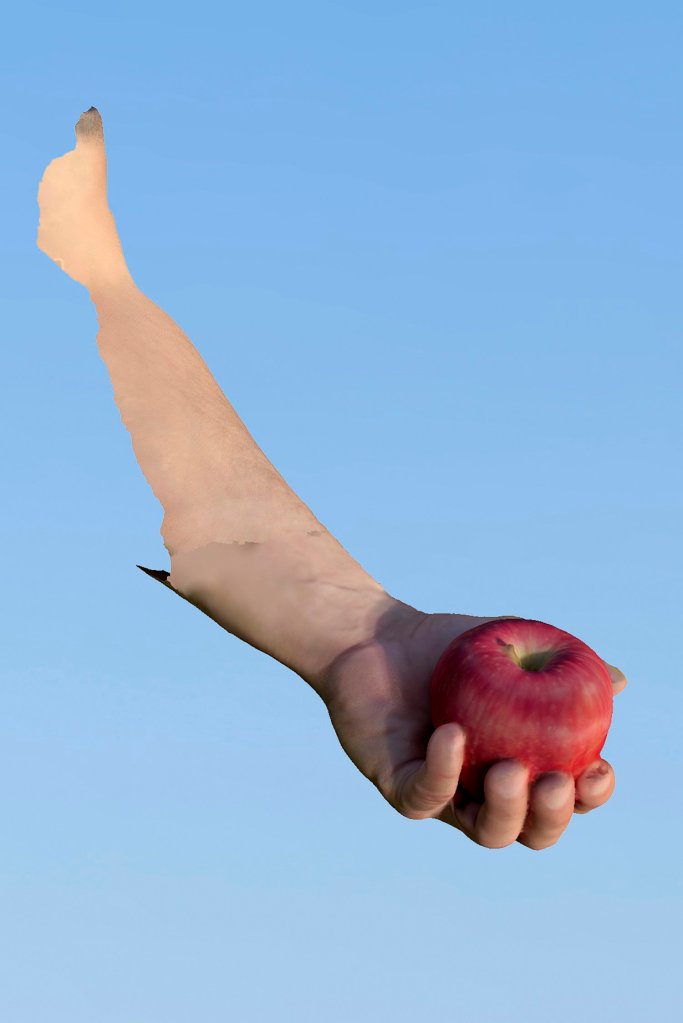
Maria Mavropoulou, from the series A Hollow Garden, 2020
‘Everything we see hides another thing, we always want to see what is hidden by what we see’, said René Magritte in connection to his 1946 masterpiece The Son of Man. The painting consists of a man in an overcoat and a bowler hat standing in front of a wall, beyond which is the sea and a cloudy sky. A hovering green apple obscures most of the man’s face. ‘There is an interest in that which is hidden and which the visible does not show us. This interest can take the form of a quite intense feeling, a sort of conflict, one might say, between the visible that is hidden and the visible that is present’.
A kindred conflicting state is pivotal in Maria Mavropoulou’s practice. If, on the one hand, the juncture between the physical and the virtual spaces we inhabit is the source of friction, on the other, it presents a new avenue for creating and experiencing aesthetic phenomena. The advancement of artificial intelligence and synthetic imagery is inescapable and will impact society in ways we are just beginning to understand. Mavropoulou is determined not to let nostalgia for past formats get in the way and has embraced the uncomfortableness of tackling novel territories; by doing so, she’s helping us to stay awake and see beyond the apple in front of our eyes.
Published in Foam Magazine #66 – MISSING MIRROR, June 2024

 paola paleari